By Giuliano Gargiulo, Spanish Ministry Intern
More Than Words
At St. Francis Episcopal Parish & Community Center, the sound of prayer often rises in two voices—English and Spanish. This is not just a matter of translation, but of transformation. Our bilingual liturgy reflects who we are: a community shaped by faith, welcome, and the movement of the Holy Spirit in a culturally diverse country.
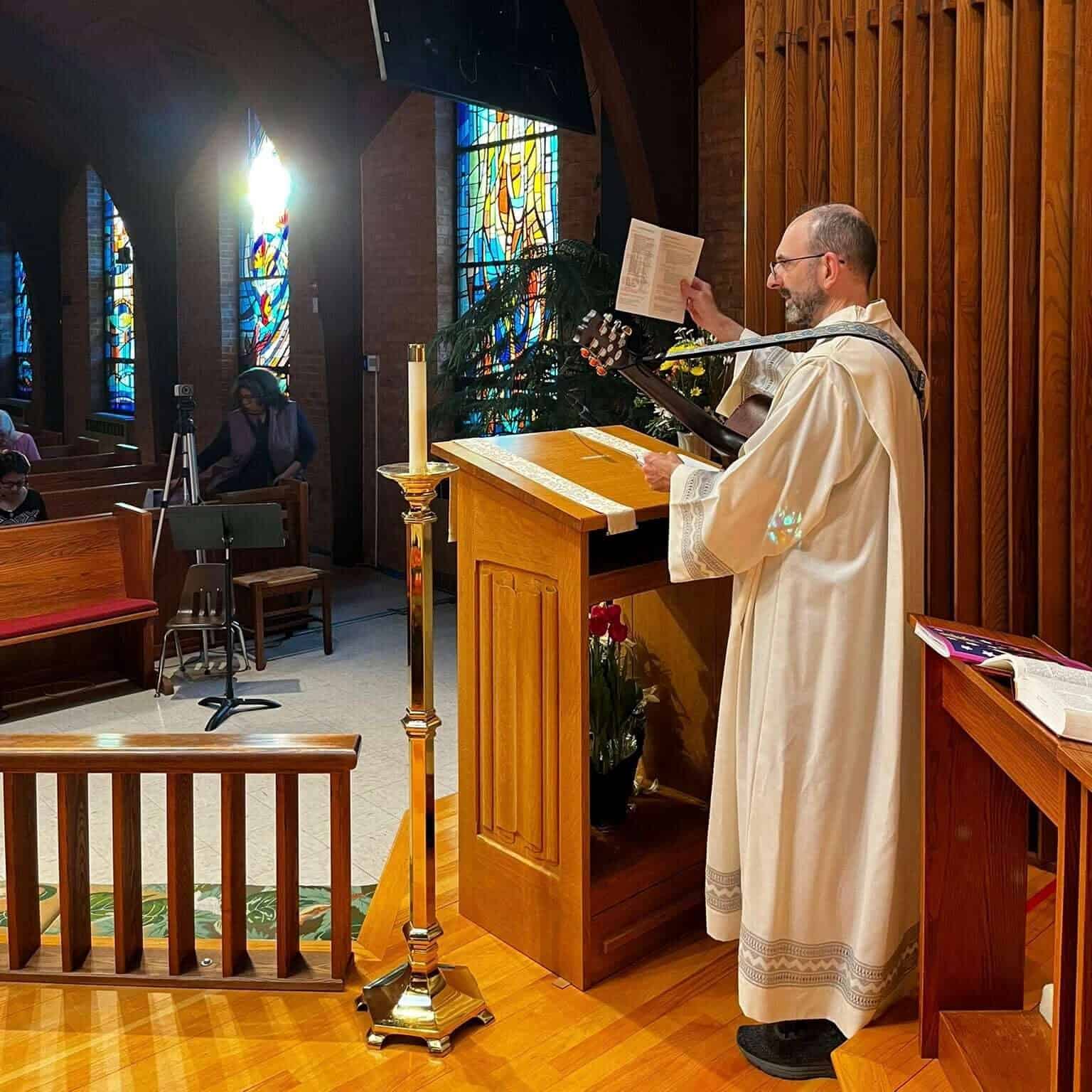
Earlier this year, our parish reached a powerful milestone: our first fully bilingual Easter Vigil. It was a night of profound joy, where three children received First Communion and one was baptized. The participation of the whole assembly—praying, singing, and celebrating in both languages—was a testament to what is possible when the Church embraces its mission of inclusion.
Each Wednesday, at our community meal, Welcoming Table Wednesday, we begin with prayer in both English and Spanish. These shared prayers are simple but deeply meaningful. They remind us that everyone has a place at the table and that our spiritual language must reflect the diversity of those we serve and love.
In this blog post my reflection goes on why we pray bilingually—not just as a gesture, but as an embodiment of our parish’s call to be a bilingual and welcoming community.
A Theological Foundation: Pentecost as Our Model (Acts 2:1-21)
The birth of the Church begins with a sound: many voices, many languages, one Spirit. On the day of Pentecost, the apostles were filled with the Holy Spirit and began to speak in different tongues. People from all over the world were astonished to hear the wonders of God proclaimed in their native languages.
This moment is no minor detail—it is a cornerstone of our Christian identity. Pentecost tells us that the Church is not defined by one language or one culture. It is a communion in diversity. It is God meeting people where they are.
At St. Francis, when we pray in both English and Spanish, we are not just offering translations—we are enacting Pentecost. We are saying that the Gospel is not tied to one tongue. We are declaring that the Spirit still speaks in many voices and through many hearts.
Language is part of God’s incarnational love. It is not neutral; it is culture, emotion, memory, and poetry. English and Spanish are not simply tools—they are vessels of grace. When we hear El Señor sea con ustedes alongside The Lord be with you, we hear not division but richness. The result is not confusion—it is abundance.
Memory and Dignity: Honoring Latino Identity
Language is where memory lives. For many of our Spanish-speaking parishioners—especially immigrants—prayers in Spanish carry profound emotional and spiritual weight. These are the words spoken by parents and grandparents; the language of first communions, blessings, lullabies, and rosaries whispered at dusk.\
When we include Spanish in our liturgies, we are not just accommodating—we are honoring. We are affirming the dignity of those whose first language is not English. We are saying, “You do not need to leave your identity at the door to enter the sanctuary.”
Too often, immigrants are told—subtly or explicitly—that their language is a barrier. In our parish, it becomes a bridge. Spanish is not a problem to be solved, but a grace to be received with reverence.
Our bilingual Easter Vigil was a clear sign of this. Families who have rarely felt fully included in English-only liturgies were able to hear Scripture and prayers in the language of their hearts. Parents could witness their children receive the sacraments in a service that reflected their family’s full identity—cultural, linguistic, and spiritual.
This also nurtures the faith of younger generations. Many of our children live between languages: English at school, Spanish at home. In our bilingual worship, they are invited to inhabit both identities with confidence and belonging.
Communion and Challenge: A Call to Mutual Hospitality
Becoming a bilingual church is not simply a decision—it’s a journey. It requires translation, coordination, patience, and mutual commitment. From preparing bilingual bulletins to selecting music in both languages, it takes time and effort. But it is holy work.
At Welcoming Table Wednesday, when we open our community meal with bilingual prayer, we begin not with logistics but with unity. We affirm in word and spirit that no one eats or prays alone.
In liturgical celebrations, the presence of both languages asks all of us—whether English-speaking or Spanish-speaking—to stretch ourselves. For some, that means embracing unfamiliar vocabulary; for others, it means speaking with courage in a language learned later in life. Each of us is called to humility and generosity.
Bilingual worship is not about efficiency—it is about communion. It reminds us that we are not consumers of worship, but participants in a living Body. It teaches us to listen more deeply, to wait for one another, and to love beyond convenience.
We do not seek to erase cultural differences. On the contrary, we honor them. But we place those differences at the altar and ask the Spirit to transform them into a shared offering. And in doing so, we discover a deeper unity—one that goes beyond language and rests in love.
Mission and Witness: Bilingual Ministry as Public Testimony
In a world increasingly fractured by fear, nationalism, and isolation, a bilingual church is a powerful witness. It says, loudly and clearly, that the Church belongs to all. It testifies that language difference is not a wall but a doorway. It proclaims a vision of belonging that mirrors the Kingdom of God.
At St. Francis, our commitment to bilingual prayer is not limited to the sanctuary. It is visible in our neighborhood outreach at the Pantry on the go, in our Wednesday meals, and in the way we greet one another. It shapes our signs, our bulletins, and our music.
It is not a feature—it is a foundation.
When newcomers enter our space and hear both languages spoken, they know they are seen. When long-time members choose to learn and adapt, they proclaim love in action. When a prayer is said in Spanish, it is not just for the Spanish-speakers—it is for the whole Body.
Our bilingual identity also challenges us. It reminds us to continually examine whose voices are heard, whose cultures are uplifted, and how we can become more fully the Church that Christ calls us to be.
Bilingual prayer is not accommodation—it is a declaration of who we are and whom we serve. In every shared word, we proclaim a Church where all voices matter, where no one is invisible, and where the love of Christ speaks in every tongue.
One Church, Many Voices
Why do we pray in two languages? Because Pentecost didn’t end in Jerusalem. Because the Incarnation dignifies every human culture. Because the Gospel belongs to the world. Because prayer, at its best, is an act of listening and a gift of love.
At St. Francis, our journey toward becoming a truly bilingual, welcoming parish is still unfolding. It is shaped week by week, prayer by prayer, meal by meal. It is guided by the Spirit, sustained by the people, and inspired by the hope that every voice matters in the chorus of God’s people.
We do not do this perfectly—but we do it faithfully. We pray in English and Spanish because our parish is called to unity, to justice, to joy, and to love. We pray in two languages because one would never be enough to express the full beauty of our community—or the full mystery of God.